
Lay Narrative
We are a bioinformatics lab developing Agenetic AI, foundation model, deep learning, machine learning, computational algorithms, and statistical methods to understand genetic, epigenetic, and cellular signaling mechanisms in the molecular regulation of cell differentiation, development, and diseases. Our research has focused on the intersection of artificial inteligence, genomics, and medicine for over 20 years.
A. Development of Artificial Intelligence, Machine Learning, Bioinformatics, and Statistical Methods.
Our research has centered on the development of artificial intelligence (AI), machine learning, statistical models, and bioinformatics algorithms to decode molecular regulation and disease mechanisms. The group’s computational research began with Kaifu’s nonlinear modeling work to predict protein-coding sequences in the human genome (undergraduate thesis, 2003–2004). During Kaifu’s PhD training, he used spectral and DNA-sequence periodicity analyses to identify sequence signatures of nucleosome positioning (Chen et al., Nucleic Acids Research, 2008), and developed a hidden Markov model (HMM) for sequence-based prediction of nucleosome positioning (Chen et al., Genomics, Proteomics & Bioinformatics, 2010). These studies established a longstanding research trajectory spanning statistical sequence modeling, machine learning, and modern AI.
The group has developed more than 30 bioinformatics methods and tools for epigenomics, RNA biology, single-cell genomics, three-dimensional genome organization, and cell–cell communication. Representative contributions include DANPOS/DANPOS2 for quantitative nucleosome and chromatin analysis; TADsplimer and StripeDiff for three-dimensional chromatin features; CEFCIG and SCIG for machine-learning prediction of cell identity regulators and genes; NanoNm for analysis of RNA 2′-O-methylation using nanopore sequencing; and MEBOCOST for inference of metabolite-mediated cell–cell communication (Chen et al., Genome Research, 2013; Xia et al., Nature Communications, 2020; Wang et al., Genome Biology, 2020; Gupta et al., Science Advances, 2022; Li et al., Molecular Cell, 2024; Arulsamy et al., Nucleic Acids Research, 2025; Zheng et al., Nucleic Acids Research, 2025).
More recently, the group has advanced AI approaches from predictive models to deep learning, foundation models, and agentic scientific workflows. Those include LINGO as a knowledge graph-grounded foundation model for single-cell lineage inference; LineageNet as a multi-graph neural network designed to infer cell lineages from static and evolving barcodes; NanoNmD that applies deep learning to single-molecule RNA-modification mapping; and MCCP and CellFun as agentic AI portals for, respectively, exploring metabolite-mediated cell–cell communication in the human single-cell atlas and supporting cell annotation and functional analysis of single-cell and spatial transcriptomics. Collectively, these efforts connect rigorous computational modeling with biologically grounded AI systems for interpreting complex molecular and cellular data.
B. Regulation of RNA Stability, Decay, and Translation by RNA Modifications and Sequence Elements with implications in mRNA vaccine and therapy.
Our research has investigated how RNA sequence elements and chemical modifications control RNA stability, decay, and translation, combining statistical genomics, machine learning, nanopore sequencing, and mechanistic experiments. We identified relatively low RNA stability as a feature of cell identity-associated genes and studied the relationship between RNA turnover and gene regulatory responsiveness (Li et al., Nucleic Acids Research, 2023). We also investigated RNA stability and regulatory control of tumor suppressor genes (Gao et al., Nucleic Acids Research, 2023).
We developed NanoNm to characterize internal 2′-O-methylation (Nm) in mRNA and demonstrated its association with increased mRNA stability (Li et al., Molecular Cell, 2024). Complementary studies identified roles for EZH2 in rRNA 2′-O-methylation and IRES-dependent translation and examined EZH2–ADAR-mediated RNA editing and RNA stability (Yi et al., Nature Cell Biology, 2021; Yi et al., Nature Communications, 2026). Building on this work, our deep-learning model NanoNmD seeks to map RNA modifications at single-molecule resolution (manuscript submitted, 2026). Together, these studies integrate computational innovation with functional RNA biology and establish a foundation for the rational investigation of RNA-based therapeutics.
C. Cell Identity Regulation by Genetic, Epigenetic, and Cell Signaling Mechanisms in Cell Differentiation, Development and Pediatrics Diseases.
A central goal of our research is to explain how genetic, epigenetic, and signaling mechanisms establish, maintain, and alter cell identity during development and disease. Our analyses of broad H3K4me3 domains and cell identity-associated transcriptional programs motivated the development of CEFCIG and SCIG, machine-learning methods that identify cell identity regulators from epigenetic signatures and DNA sequence features (Chen et al., Nature Genetics, 2015; Xia et al., Nature Communications, 2020; Arulsamy et al., Nucleic Acids Research, 2025). This work links interpretable genomic features to computational predictions of cellular identity.
Using integrated single-cell and epigenomic analyses, we identified MECOM-associated regulation of endothelial lineage identity and TCF4-mediated restraint of endothelial-to-mesenchymal transition (Lv et al., Nature Communications, 2023; Xian et al., Nucleic Acids Research, 2025). Our collaborative studies also revealed AIBP-mediated cholesterol efflux and SREBP2–Notch signaling in hematopoietic stem and progenitor cell fate, enhancer–promoter regulation during cardiomyocyte maturation, and H2A.Z-associated chromatin organization in adipocyte thermogenesis (Gu et al., Science, 2019; Zhou et al., Developmental Cell, 2023; Zhang et al., Nature Metabolism, 2026).
To extend mechanistic understanding from individual cells to cell populations, we developed MEBOCOST to infer metabolite-mediated intercellular communication and applied computational analyses to diverse single-cell atlases (Zheng et al., Nucleic Acids Research, 2025). Our ongoing LINGO and LineageNet projects apply knowledge graph-grounded foundation modeling and multi-graph deep learning to reconstruct cellular ancestry from lineage-tracing data, while MCCP and CellFun develop agentic AI interfaces for atlas-scale communication and functional analyses. These advances aim to connect cell identity, lineage relationships, and multicellular signaling in a unified computational framework.
D. Genetic Mutations and Epigenetic Dysregulation in Cancer Development, Progression, and Therapy Resistance.
Our research has elucidated how genetic mutations, chromatin dysregulation, and transcriptional control contribute to tumorigenesis and cancer progression. Integrative analysis of epigenomic and cancer genomic data linked unusually broad H3K4me3 domains to cell identity genes and tumor suppressors, and subsequent studies examined MLL4-dependent chromatin regulation, broad repressive domains, and mechanisms of oncogene silencing (Chen et al., Nature Genetics, 2015; Dhar et al., Molecular Cell, 2018; Zhao et al., Nature Communications, 2020). These studies illustrate how quantitative genomic analyses can reveal cancer-relevant regulatory mechanisms.
Through collaborative cancer studies, we investigated epigenetic regulators and transcriptional programs involving BMI1, EZH2/EED, and CHD6 in prostate cancer and therapeutic resistance (Zhu et al., Nature Communications, 2018; Liu et al., International Journal of Cancer, 2019; Zhu et al., Oncogene, 2020; Zhao et al., Nucleic Acids Research, 2022). Additional studies connected chromatin-regulatory alterations to vulnerabilities in melanoma and medulloblastoma (Terranova et al., Cell Reports, 2021; Dhar et al., Cell Reports, 2025).
Our research has also examined mechanisms of genome instability and mutational processes, including Dna2-associated complex insertions, EndoG-related genome maintenance, and factors limiting insertions at DNA breaks (Yu et al., Nature, 2018; Yu et al., Nature Communications, 2024; Yu et al., Nucleic Acids Research, 2025). These findings complement our computational cancer genomics research by linking DNA damage and repair mechanisms to the origins of genetic alterations. Our ongoing work on mutator-gene alterations and immunotherapy efficacy is a related translational direction (preprint).
E. Molecular and Cellular Mechanisms of Immunity, Inflammation, and Tumor Immunotherapy.
Our research has contributed to understanding immune cell regulation, inflammation, and tumor immune responses through AI-enabled single-cell analysis, computational genomics, and collaborative mechanistic investigations. We investigated how macrophage epsins shape inflammatory macrophage states, cytokine signaling, foam-cell formation, and pathological vascular cell transitions in atherosclerosis (Arulsamy et al., Arteriosclerosis, Thrombosis, and Vascular Biology, 2025). Related work explored epsin-targeted nanotherapy and mechanisms of atherosclerosis regression (Cui et al., Circulation Research, 2023; co-corresponding author). These studies show how single-cell computational analysis can connect immune-cell heterogeneity to disease mechanisms and therapeutic strategies.
In collaborative immunology research, we showed that OX40 costimulation inhibits Foxp3 expression and regulatory T-cell differentiation, identified Beclin 2 as a negative regulator of innate immune signaling and inflammation, and investigated interferon signaling during endothelial responses to viral infection (Zhang et al., Cell Reports, 2018; Zhu et al., Journal of Clinical Investigation, 2020; Chau et al., Frontiers in Cardiovascular Medicine, 2024). More recently, we studied FGFR-associated resistance and immune evasion in PIK3CA-driven endometrial cancer, linking altered antigen presentation and an immunosuppressive tumor microenvironment to the response to anti-PD-1 treatment (Cheng et al., Nature Communications, 2026).
The integration of single-cell, spatial, and AI-based approaches across these projects provides a framework for dissecting immune states and interactions, prioritizing molecular mechanisms, and generating hypotheses relevant to immunotherapy. Our ongoing MCCP and CellFun agentic AI projects extend these capabilities to exploration and interpretation of large human cell atlases.
In summary, our research integrates AI, machine learning, biostatistics, computational genomics, and experimental biology to uncover molecular mechanisms underlying gene regulation, cell identity, and human diseases. Over the past nearly two decades, we have developed innovative computational and statistical methods, progressing from probabilistic modeling to deep learning, foundation models, and agentic AI. These advances have enabled discoveries in RNA regulation, cancer genetics and epigenetics, cell fate determination, inflammation, and tumor immunotherapy. By combining methodological innovation with mechanistic and translational research, our work aims to transform complex biomedical data into actionable biological insights and new opportunities for disease diagnosis and therapy.
Technical Narrative
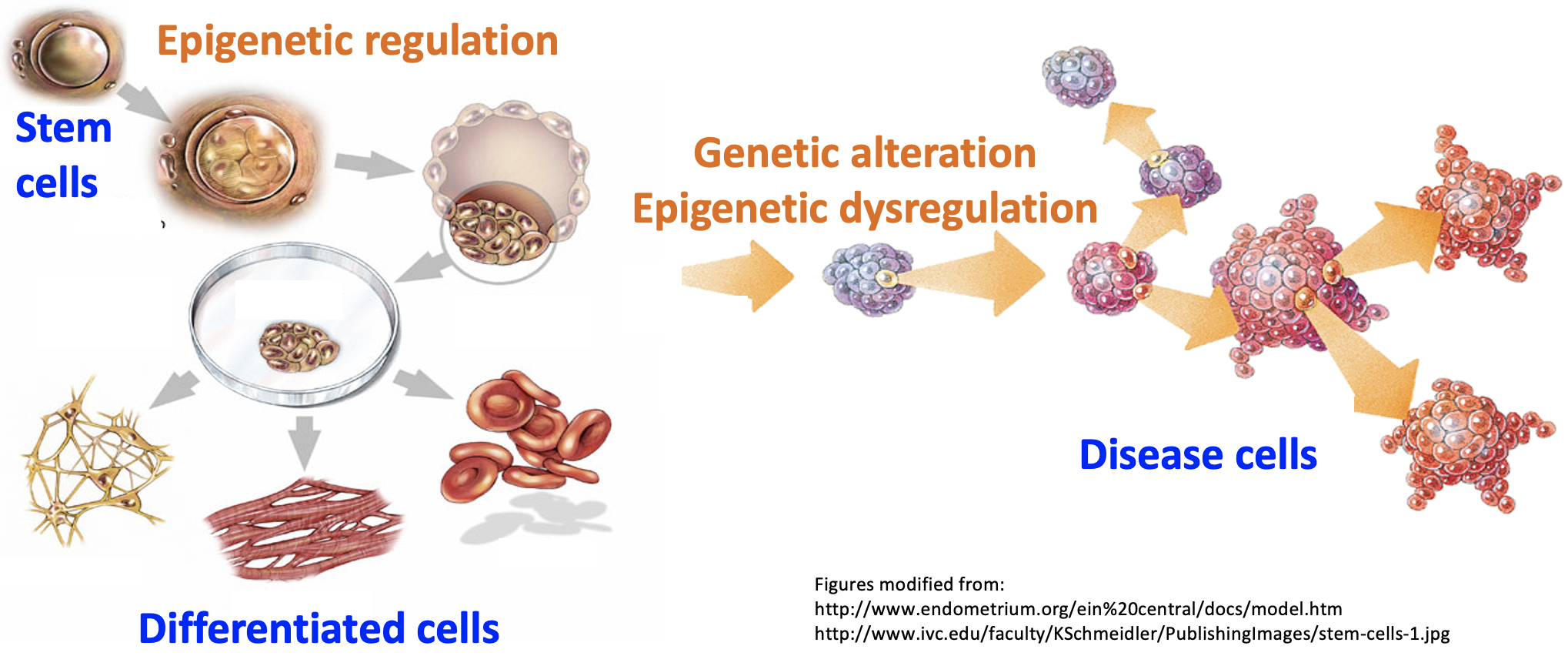
Different cell types in a healthy body share the same genetic sequence. Difference in identity of these cell types is determined by epigenetic regulation of gene expression, which represents an consequence of the interaction between the genetic factors and signaling molecules in the cell. Genetic mutations and abnormal signals can lead to epigenetic alteration and cause cell identity dysregulation in diseases.
Research in the lab is centered around one fundamental insight into basic biology: the regulation of cell identity genes exhibits a higher degree of complexity compared to many other genes, such as housekeeping genes. Our interest in this phenomenon starts from computational modeling showing that the H3K4me3 modification breadth on chromatin follows a bimodal distribution (Nature Genetics, 2015). Specifically, cell identity genes within a cell tend to exhibit a broad H3K4me3 pattern, spanning both the promoter and gene body regions. For instance, the CD4 locus displays a broad H3K4me3 pattern in CD4+ T cells. Conversely, the majority (~95%) of expressed genes, including housekeeping genes, exhibit a sharp H3K4me3 pattern solely at the promoter. This observation echoes several findings from other laboratories, such as the Brunet lab’s work on H3K4me3 breadth (Cell, 2014) and the Young Lab’s research on super-enhancers (Cell, 2013). Furthermore, our research has revealed that cell identity genes tend to be regulated by a subset of super-enhancers marked by CTCF binding (published in GPB, 2021) and exhibit low RNA stability due to co-transcriptional RNA m6A modification (Nucleic Acids Research, 2023). These findings collectively demonstrate that cell identity genes experience a more rapid turnover in expression, encompassing both frequent transcription and mRNA decay, compared to other genes expressed at a similar level. Motivated by these findings, we developed CEFCIG, an artificial intelligence technology designed to identify cell identity genes based on the intricate nature of their expression regulation (Nature Communications, 2020). As a proof of concept, our application of this novel technology to endothelial cells has unveiled MECOM as a regulator of endothelial cell lineage (Nature Communications, 2020; Nature Communications, 2023). This research direction holds significant implications for a wide array of research communities, addressing critical challenges of cell identity conversion technologies and overcome a crucial obstacles hindering the advancement of cell therapy.
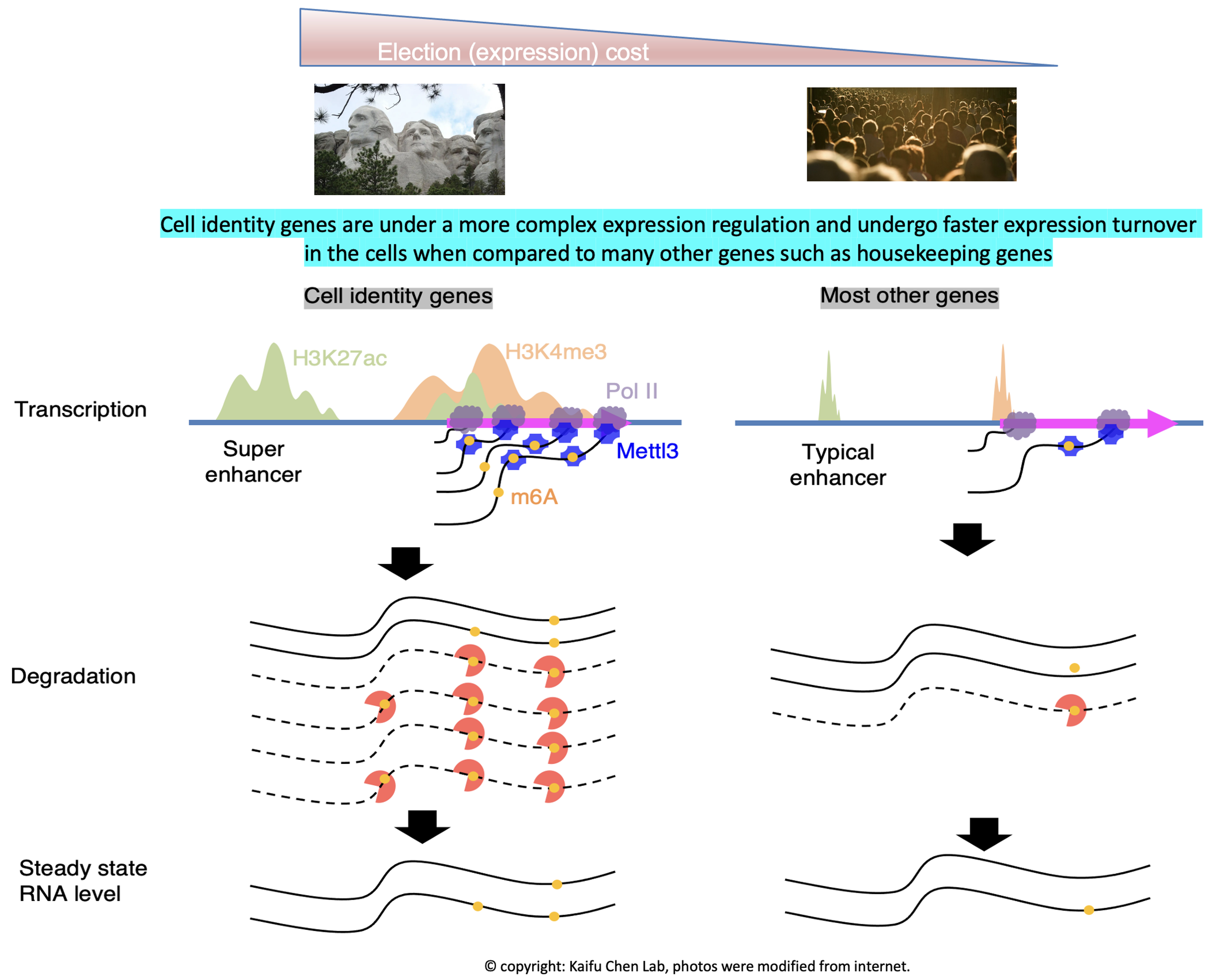
Our research findings offer a compelling rationale for targeting the intricate regulatory complexity governing cell identity genes in diseases linked to cell identity dysregulation. The heightened complexity of expression regulation at cell identity genes makes them particularly sensitive to manipulation of the associated molecular pathways. For instance, in our experiments, the knockout of the H3K4me3 methyltransferase MLL4 demonstrated that genes marked with broad H3K4me3 profiles were more susceptible compared to those with sharp H3K4me3 profiles. This vulnerability led to tumorigenesis and loss of normal cell identity (Molecular Cell, 2018). Additionally, the lower RNA stability observed for cell identity genes, attributed to their greater enrichment of co-transcriptional RNA m6A modification catalyzed by METTL3, revealed that knockdown of METTL3 had a more pronounced impact on RNA stability of cell identity genes compared to other genes (Nucleic Acids Research, 2023). Given that MLL4 and METTL3 may also influence many other expressed genes, there was a theoretical concern about potentially broad side effects when targeting these enzymes. However, our research suggests that a moderate dosage of MLL4 and METTL3 targeting may preferentially affect cell identity genes while exerting negligible effects on other genes. These findings provide a compelling justification for considering the therapeutic targeting of mechanisms govering the regulation complexity of cell identity genes in diseases associated with cell identity dysregulation.